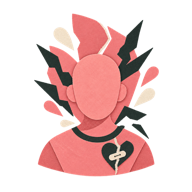
These feelings are reading cues. They can overlap, change, and differ from your own.
I was ten years old when I thought I had finally found safety. My mother's life had been chaotic, filled with instability and arguments over custody. My father, my adoptive father, had taken us in. He promised us a beautiful life: a real bedroom, a stable school, and friends. He told us we were his daughters and that he loved us. For a moment, I believed him. I was happy. I thought I was living a normal childhood.
But the happiness was a trap. My father had a partner, a woman I called my stepmother. From the start, I felt we didn't belong. She wanted him all to herself. She had a hold on him that was terrifying. She would take his makeup, smear it on the bathroom furniture, and then accuse us of stealing it. When my father didn't believe me, I realized she had total control.
I told my sister I would take the blame because if one of us had to die, it should be me, the older one. But the punishment was worse than death: being hung by a…
The punishments started small but grew into something inhuman. At first, it was just writing apology letters to her all day. She would watch us write until our wrists ached, then tear the pages up and make us eat them. But it escalated. We were starved. At night, we were locked in our rooms and tied up. She installed toothpicks in the cupboard doors; if we opened them to find food, the toothpick would fall, and she would tell my father we had escaped. He installed a camera in the hallway to watch us.
I remember the cold baths. Once, she tried to drown me, pushing my head under the water while my sister watched. There were nights I was tied to a chair. But the worst punishment happened on her birthday. She wanted to make a fruit cake. I saw the trouble brewing and knew my younger sister couldn't handle the blame. I told her I would confess. I said it was me. If one of us had to die, it should be me because I am older.
I took the blame. I said I stole the can of pineapples. My father found out. He took me to the garage. He stripped me and hung me by my arms from a gas bottle. The weight of the bottle lifted me. I stayed there all afternoon. My sister came down, saw me, and was so traumatized that later she drew me hanging by my feet, even though I had never been hung by my feet. That night, my father told me I understood that stealing was wrong. Then he took an electric sander and sanded my arm. The next day, I went to school with a fresh wound.
I couldn't speak. If I spoke, I would lose my father. It was my word against hers, and she had such power that she could turn everything around. She could make it seem like we deserved it. She could make it seem like we were just like our mother. The abuse continued with forced feeding. We were tied to chairs and made to eat expired food, including candies and spinach mixed together. If one of us vomited, the other had to eat it. When I vomited, he chased me with a broom handle and hit me so hard I thought he had pierced my eye. I shouted that we were going to die.
It took the school to save us. I was seeing a psychologist, and social workers came to the house, but we were conditioned to stay silent. One morning, after recess, the principal came to get me. I thought I was in trouble for stealing snacks. Instead, two officers were in the office. They asked me why they were there. I didn't understand. They said, "Your father." I realized it was over.
I was questioned all day. That evening, I was taken to an emergency shelter. My father was never allowed to see me again, except at the trial. My sister was taken a few weeks later. I was terrified for her. I arrived at the shelter late at night, hoping to see my older sister, but she had just left. I was alone and young. I felt safe in a way, but I didn't know where I belonged. I had been saved, but I had lost everything.
Looking back, I don't know if my father ever loved us. I think he was engaged in a power struggle with my mother, and we were just objects in that fight. But the cruelty, the suffering, the starvation—it wasn't just a fight. I think he was sick. Adults who treat children like objects, who torture them, who make them eat their own punishment, seem like monsters. We couldn't speak because of fear, guilt, and shame. It is up to adults to see the signs and to act before it is too late.
This story describes one person’s experience. It does not diagnose anyone, and similar situations may not have the same meaning.